  1. Blog
  2. Article

David Callé
on 21 November 2016

How to build your own Ubuntu Core image and other documentation add-on
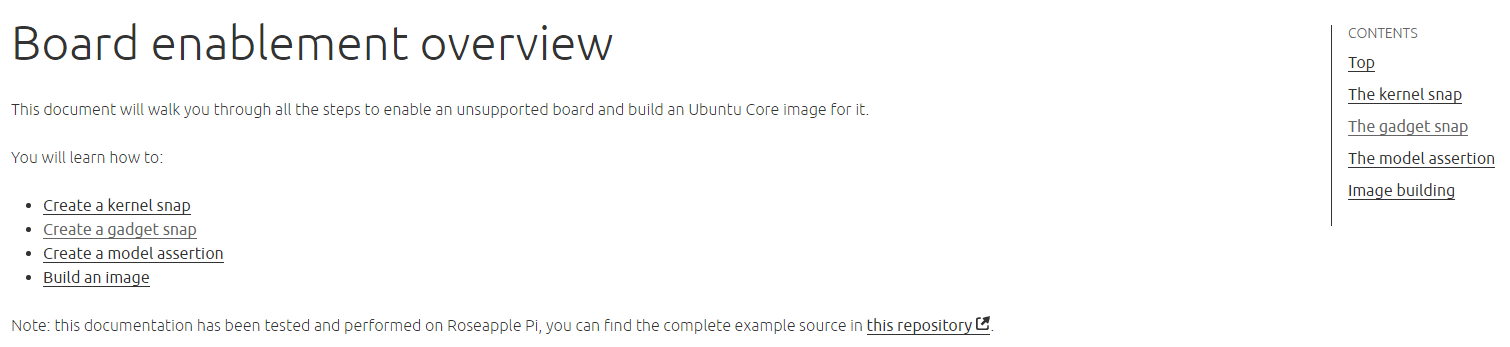


2 weeks since the launch of Ubuntu Core 16! Many of you have been asking for help porting Ubuntu Core to new boards, chips or simply building your own images for supported boards like the Raspberry Pi. Wait no more!! Here is the first piece of documentation to help you build an Ubuntu Core image for your preferred board.

New documentation

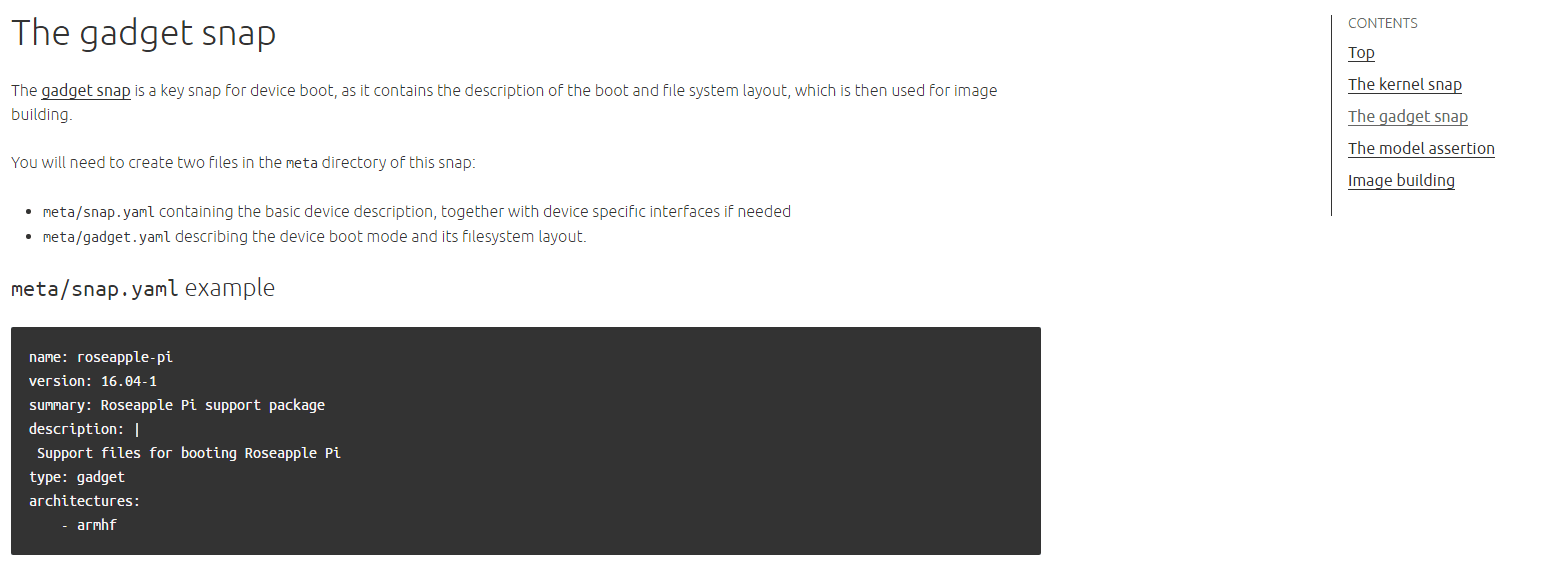
The new Board enablement documentation gives a set of instructions for advanced users to help them enable new boards and build images, including kernel building, gadget snap composition, signature generation and model assertion creation.

The latest new interfaces have been added to the core interfaces reference:

  • `raw-usb` allowing access to connected USB devices
  • `lxd`, allowing usage of the LXD API through the LXD snap

Updates

The Security and sandboxing overview has been augmented with debugging guidance to investigate which authorizations your apps need to request to work within security confinement.

Improved looks

The doc interface also got a few enhancements, with an in-page navigation menu on the right hand side which will help navigate through long pages (and yes there are a few long pages 🙂 .
Related posts


Massimiliano Gori
2 March 2026

Supporting more identity providers on Ubuntu with the new Authd OIDC broker

Cloud and server Article

Today we are announcing the general availability of the new generic OpenID Connect (OIDC) broker for Authd. With enterprises needing to centralise access management controls, the ability to choose your own identity solution is paramount. This new broker snap is our answer to that need, allowing Ubuntu Desktop and Server to integrate with ...


Bertrand Boisseau
2 March 2026

Cloud-native Android™ infotainment: your CI pipeline shouldn’t depend on hardware

Automotive Article

More and more often, infotainment systems are being developed and delivered like software, yet often they are still tested and validated using hardware-centric processes. This is far from ideal: access to devices is limited, environments are difficult to reproduce, and iteration slows down as soon as multiple teams need to work in paralle ...


Benjamin Ryzman
28 February 2026

Meet the wildlife conservation AI 5G hotspot at MWC Barcelona 2026

AI Article

From March 2-5 in Barcelona, Canonical will present a working wildlife conservation platform that combines open source 5G, AI, and cloud-native infrastructure in a travel friendly form factor. At the center is a portable 5G AI hotspot built on Ubuntu and Canonical Kubernetes, running on Arm-based Ampere servers. It connects drones, trail ...